Sunday, November 28, 2010

Druze: The Unfortunate, Untold, Unheard Story of Israel

Due to the constant disputes between the Jews and Arabs in Israel continuously propagated by the media, very little have paid attention to the numerous other ethnic and religious minorities of this region. One of those under-the-radar minority groups of Israel would be the Druze. Although very little is known about their religious backgrounds and theological belief system, one thing has become quite apparent over the years: while technically considered Israelites, they have been subjected to discrimination and persecution by the state of Israel.

While discrimination of any form is always a discouraging realistic matter when confronted, what makes this particular situation even more depressing is the unprecedented historical contribution and significance that the Druze have had in the defense of Israel. Journalist Ari Bussel in the article titled, "The Druze Minority in Israel", where he provides a brief but concise description of this disadvantaged minority, explains that, unlike the Arabs, the Druze have served immensely in the military and see it as their obligation to Israel. As matter of fact, Donna Rosenthal, author of The Israelis: Ordinary People in an Extraordinary Land, explains that Druze are the only non-Jewish group of Israel who perform compulsory military service, hence explaining the fascinating phenomenon that a higher proportion of Druze than Jews serve in the IDF (296 and 297). According to a statistic that Bussel presents, "96% of [Druze] men serve, mostly in combats units, the full term length required". No other non-Jewish (or Jewish) group of Israel can even compete with this astonishing patriotic duty!

Besides showing their magnificent sense of loyalty toward the State through their military service, they have immensely influenced Israel in the political world as well. Bussel emphasizes the fact that many notable Druzes have served in the UN and the Knesset, one of whom is currently the deputy minister for the development of the Galilee and the Negev and Regional Cooperation, Ayoob Kara. Furthermore, relative to their percentage in society, they have also been "over"-represented in the Knesset. 

Unfortunately, while their sacrifices and loyalty to Israel is more than evident, and deserves to be highly recognized, Druze have been the victim of various ethnic discrimination and persecution. Bussel argues, while in the military, the Druze are Israelis, however, once outside, they feel and are treated differently (due to their Arab appearance), as they return to their communities. One vivid example was illustrated beautifully by Donna Rosenthal. She described an incident that occurred near Haifa in 2001, where "a Druze couple pushing their baby stroller in the Gand Canyon Mall were assaulted verbally and physical by a group of Jews who mistook them for Arabs" (298). Ironically, the victimized husband was actually an off-duty IDF soldier. 

Furthermore than just personal attacks, virtually every Israeli Druze village has been receiving inequitable government funding when compared to Jewish towns. From, Daliat al-Carmel, the largest Druze village in israel, to Beit Jann, the town to have lost the highest proportion of their soldier-sons than any other place in Israel, the Israeli government has shown significant neglect and betrayal, seeming to focus more on "building the Palestinian economy rather than strengthening that from within which is most loyal to Israel".  

With all these difficulties and mistreatment building-up over the years, many Druze have reached their boiling point and believe their time for compensation is more than overdue. While still not seeking excuses to avoid serving, or resorting to radical terrorist attacks, this disadvantaged minority group have staged several public protests to present their unknown victimization. 
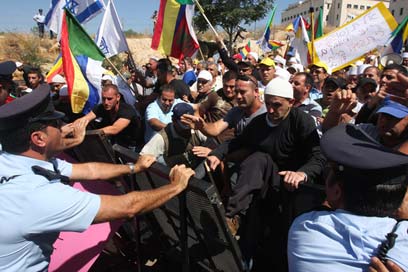
In the blog post titled, "Israeli Druze Protest Against Discrimination", emotions are manifested in a mass protest demonstrating the tears and frustration from a group of people that have sacrificed so much for a country that continues to treat them as second-class citizens. Although the author is not mentioned, the writer unquestionably argues on behalf of the Druze, expressing their rightful demand for ethnic equality and fair state support toward their neglected communities. In this Israeli Druze protest, various placards and posters were portrayed, including one that so simply yet accurately depicted the unfortunate circumstance that these Druze face. It states, "Our soldier serve at the front but there's no state support at home." 

As an American citizen who is deeply convicted in how wrong it was for the white Euro-Americans to have racially discriminated against the ethnic minorities in our country, I believe it is only right for the Israeli Druze to continue their public outcry against this unfair and unequal treatment from the Israeli government. It should not even be an opinion, but a common fact, that the Israeli Druze have served their debt to their country, and hence deserves every right, privilege, and opportunity that the Israeli Jew receives. Honestly, what more can anybody ask for from such as a loyal, patriotic, and nationally devoted group of people. We, as Americans have learned, through much bitter conflicts and unfortunate deaths, the evilness of discrimination and only hope that not much unnecessary blood gets spilled before Israel comes to the same absolute realization.

In regards of reliability of the articles and blog posts utilized in this blog, both sources pertains to be quite reliable and accurate in their information presented. Although the blog post titled, "Israeli Druze Protest Against Discrimination", did not state the author, the post was taken from the Al Arabiya internet news service, predominately know for carrying news current affairs, business, and documentaries. While some critics have dubbed it to be "anti-Jewish", any "pro-Arab" or "pro-Muslims" bias would be irrelevant in this particular issue since Druze are not considered to be traditional Arabs or Muslims. In regards of journalist Ari Bussel, the author of the article, "The Druze Minority in israel", he is a reporter and an activist on behalf of Israel. He is also currently residing in the state of Israel and specializing in Israel Diplomacy's Front for Canada Free Press. While it becomes clear that he holds this undeniable defense for Israel thorugh his biased sympathy for the State and the pro-Israel depiction of his online article, I found it interesting for him revealing Israel's woes against a minority group rarely noticed. With that said, although It is evident that both sources seemed to have been written under a personal agenda in expressing remorse toward this unfortunate minority, I still believe both holds enough credibility and reliability in regards of this issue.

For more information please see:

http://www.ynetnews.com/articles/0,7340,L-3734470,00.html

Saturday, November 20, 2010

The Orthodoxy Israeli Settlers: A Friend or Foe Toward the Peace Talks?

The public image of Israel's Orthodox settlers residing in the West Bank has been one of belligerent, bigoted youths, and rightwing extremists who are "vociferous opponents of withdrawal, claiming an ideological attachment to the land," and committed to see hostile Palestinians "transferred" out of this supposed sacred Biblical land. The criticism continue as opponents claim that the settlers violate international law, legitimize force by armed messianic Jews and ruin the chance of establishing a viable Palestinian state. WIth that said, it should not be much of a surprise that many have been blamed as the ultimate barrier preventing the long-awaited peace negotiation between Israel and the Palestinians. However, although many continue to strongly hold to this shallow belief regarding this particular group of people, others are transforming their perspective, considering them now as the possible, potential solution to this complex issue. 

In the article titled, "In West Bank Settlements, Sign of Hope for a Deal," by Ethan Bronner, and blog post titled, "Israel's Orthodox Versus the State," by Sarah Harlan, a different perspective is offered expressing Israel Orthodox settlers who are eager in withdrawing from the West Bank to further progress toward a mutual agreeable solution. 

Both Bronner and Harlan focuses on two particular ultra-Orthodox Israel communities situated in the West Bank which consists of the majority of Israel's Orthodox settlers, and half of all construction taking place in West Bank settlements: Modiin Illit and Beitar Illit. While these places may represent strict religious observance and study, they yearn for compromise with their fellow Palestinians neighbors. The authors argue that most ultra-Orthodox do not consider themselves settlers or Zionists and express no commitment to being in the West Bank. They explain, most settlers did not (and do not) necessarily migrate in this geographic region to continue the historic Zionist mission of reclaiming the Jewish homeland, but instead out of affordability and accessibility. Once housing became no longer available in Jerusalem for these ultra-Orthodox Jews, or were either rejected by other Israelite cities due to their occult-like culture, many found the West Bank as their ultimate last resort. As Mayor Yaakov Guterman of Modiin Illit stated, "We are not here for political reasons…ninety percent of the people are here for the affordability, not for ideology". 

With that said, relocation of these settlements is not only probable, but expected. Since they appear less ideologically  committed to the West Bank, opposition toward the establishment of a Palestinian state has decreased substantially. Although other important factors must be taken into consideration such as housing availability in Israel, border realignment, and safety concerns, withdrawing from this territory is still highly feasible with support coming from all directions. When Mayor Guterman was asked about the prospect of a Palestinian state rising one day on his own town line, he responded, "We will go along with what the world wants. We have gone through the Holocaust and know what it means to have the world against us, The Torah says a man needs to know his place. "

So, although the Israeli Orthodox settlers have been pegged in the media as that undesirable force that continues to maintain Israel intractable on land issues in the peace process, others view it as an exaggeration or an excuse for failures to move the peace process further. As Dr. Gershon Baskin, a well-known Israel-Palestin public policy expert, had clearly put it, "The ultra-Orthodox are simply 'not a primary factor' in the stalled peace process". 

While there was virtually no information accessible concerning the blogger, Sarah Harlan, disallowing further criticism on the credibility of her posted work, much was obtained on the following writer, journalist Ethan Bronner. Personally renowned for his prolific works as a news correspondent, he is currently Jerusalem's bureau chief of New York Times since March 2008, following four years as deputy foreign editor. Although of American origin, he seemed to have written extensively upon Israel's peace talks, the West Bank crisis, and other current Middle East issues, validating his reliability in providing us a credible published article involving this particular issue. 

If their is anything I might question, it would be the source from which this article was derived from: the New York Times. Notorious for its left-leaning liberal news (at times even accused for being anti-Israel and pro-Islamist), I tend to find their news very biased and distorted. However, I must admit to see it was a big surprise to see this article emerging from this American daily newspaper, as it seemed to sympathize and at times even emphasize with this highly controversial, conservative, Orthodox Israelites.

Wednesday, November 10, 2010

The Effects of Ruling a Modern Society Through Ancient Traditional Law: Israel’s Experiences First-Hand

There is a great deal of tension in Israeli society between those who adhere to a secular position (in other words asserting the need for total separation of state and religion, with civil law governing all aspects of life) and those who maintain that as a Jewish State, the country should be governed by Jewish law and reflect the traditional and religious culture of the Jewish people. Since the time of its creation in 1948, the State of Israel has always had to mediate controversial issues regarding mixtures of old and new, and religious and secular values and ideals. Over the years, various degrees of compromise have been achieved in efforts to resolve these conflicting positions, but, in the end tension still seem to exist against the status quo. One such compromise is that all matters pertaining to marriage and divorce are under the jurisdiction of the Ministry of Religious Affairs. With that said, for the Jewish population, therefore, divorce is handled by the rabbinical authorities.

While the civil courts do hold some power over matters stemming from separation and the dissolution of marriage such as child support, custody, and division of property; the final act of legal divorce in Israel does still seem to rest upon rabbinical authority. With this unfair monopoly over marriage and divorce, much concern has arisen over its indirect provocation of women inequality and mistreatment. From newspaper articles to online news posts, various individuals have expressed their frustration over the Jewish law which supposedly states that “a man has to agree to grant the divorce of his own free will before the legal separation can proceed”. They argue that this system ultimately unfairly discriminates against women.

Stories have been published and personal experiences shared presenting certain scenarios where unfortunate wives have been unable to gain their freedom or right to remarry because their estranged husbands have refused to grant them their "get". Or even worse, there have even been some extreme cases where the wife have been bribed in only being granted their "get" by their husband if, and only if, she were to give up her claim on joint property or give up her right on child support.

According to Donna Rosenthal, in her book titled, The Israelis, this whole dilemma originates from the implementation of the Torah teachings into Israeli law. In the book of Deuteronomy 24:1 it states, “He [God] writes a bill of divorce and puts it in her hand”, which many Orthodox Jewish Rabbis have interpreted as meaning no woman can divorce without her husband consent. As a way to relieve their frustration, many have blamed this problem based on the overly-dominant influence that this fossilized, outdated, Torah-based system is having when enforced on a modern 21rst-century society.

While this issue does seem to be a relevant, sensitive crisis currently occurring in Israel, there has been some who counter pose this argument, reinforcing the belief that Jewish Torah-based law, such as Israel’s divorce system, promotes equality and a sense of fairness. Rueven P. Bulka, a noted author, is one of those advocates. In his online post, Jewish Divorce Ethics, he claims that “the right of the wife to demand a divorce is as legally entrenched as is the right of the husband to demand a divorce”. By examining the Torah’s forewarning against taking advantage of orphans and widows, he views this ancient religious book as well as Jewish traditional law as being virtually impossible to “entrench vulnerability of the wife within the marriage”. He continues in asserting that if anything, the sense of fairness and concern for all individuals no matter what their position or station in life, is a central feature of the Torah. Although he does admit that certain inequities does currently exist in the Israeli divorce system, he goes on to add the following: “No one can deny that there are inequities in the system, but these inequities emanate more from abuse of the system rather than from its basic weaknesses”. All in all, he claims the man is the one to condemn and eventually fix, not the system.

While respecting Bulka's positioning on this issue, I still, however, continue to side with the former argument believing strongly that the root of the divorce crisis is based on the outdated theocratic system being implemented on a modern democratic nation. Yet, to be fair and credible in my assessment, it would only be proper to portray the authorial viewpoint of the various authors used in this blog.

The authors and bloggers responsible for writing and publishing the argument in opposition to the Israeli divorce system and its perceived negative consequences all hold solid credibility for their information presented and frustration expressed. Many are accredited journalist and news staff writers who have relocated themselves to Israel several times to portray reliable correspondents based in the Holy Land. For example, Lourdes Garcia-Navarro spent three years as NPR's foreign correspondent in Jerusalem, reporting from that region as well as on special assignments abroad.

However, one must always take every factor into consideration when analyzing reliability and credibility. For instance, it should also be noteworthy to point out that Lourdes Garcia-Navarro is a foreign correspondent for the media organization, NPR, which has been criticized consistently for its liberal bias. In addition, other journalists who have expressed outrage against this divorce system have participated in many feminist sponsored events, and have spoken to many audiences in Israel and America on Jewish Women’s and Spiritual topics. For instance, Barbara Sofer, alone served as a Scholar-in-Residence at the Young Women’s Voices Conference in January 2001, the MAC Young Women’s Institute, Detroit February 2004, and the Women of the West Conference in Dallas in May 2005.

On the other hand, as powerful and persuasive Bulka’s argument may have been, it should be noted that more than being an accomplished author, a profound lecturer, and a Jewish activist, Rabbi Rueven P. Bulka is a rabbi of Congregation Machzikei Hadas in Ontario, Canada, and is the co-president of the Canadian Jewish Congress. Representing such a powerful religious position in the Jewish sector, it would only seem obvious for him to stand firm upholding the importance and prominence of traditional Jewish laws, including the Israeli divorce system.

Other Additional Sources:

Rosenthal, Donna. The Israelis: Ordinary People in an Extraordinary Land. New York: Free Press, 2003.

http://www.onlinelibrary.wiley.com/doi/10.111/j.174-1617.1990.tb01235.x/pdf.

Thursday, October 14, 2010

Families of Gaza flotilla victims accuse Israel of war crimes in The Hague

As if not enough tension has already accumulated in the the MIddle East involving Israel during the past recent weeks, a delegation representing three-hundred activists filed complaint over Israel's raid on Gaza-bound flotilla which left nine activists dead.  Discussed in the article, Families of Gaza Flotilla Victims Accuse Israel of War Crimes in The Hague, by Danna Harman, the delegation, consisting of numerous victims' families and a Turkish non-government organization under their legal representative Ugur Sevgili, strongly believe war crimes against humanity had been committed during the May 31 raid, and insist that the International Criminal Court in The Hague further investigate upon this matter. "We demanded from the prosecutor to initiate an investigation and prosecute the perpetrators of those crime," Sevgilli said. "We didn't mention any Israeli soldiers or any Israeli politicians. We just told them that we believe war crimes and crimes against humanity were committed."   


Although Sevgilli and many family members of the Gaza-bound flotilla victims certainly believe that the Court will initiate prosecution, unfortunately many suspect that due to its political atmosphere, politics might get in the way of justice. For example, a similar prosecution that took place last September founded that Israel violated certain human rights  law during its interception of a flotilla destined for Gaza. Israel, however, completely rejected the panel's finding arguing the investigation was completely conducted by pro-Palestinians sympathizers, hence resulting in a biased conclusion. 


By further augmenting the Israel/Palestinian historical dispute, since nine of the victims killed during the incident were Turkish citizens, it weakened an already fragile relationship between Israel and Turkey, previously Israel's strongest ally in the Muslim world. 


Is this it
To further instigate problems, this accusation of war crimes has kept Israel on the defense over its much disputed, controversial Gaza blockade. It orginally took form in June of 2007, when the Palestinian Islamist political party, Hamas, took control of the Gaza Strip, and removed the Fatah (the former major Palestinian political party under power)  officials through the Battle of Gaza; seizing government institutions and replacing Fatah and other  government officials with its own. Following the takeover, Egypt and Israel largely sealed their border crossings with Gaza, on the grounds that Fatah had fled and was no longer providing security on the Palestinian side. 


Over the years, Israel maintained that the blockade is necessary to limit Palestinian rocket attacks from the Gaza attacks from the Gaza Strip on its cities and to prevent Hamas from obtaining other weapons. However, facing mounting international calls to ease or lift their blockade, Egypt and Israel lessened the restrictions starting in June 2010. With further incidents such as this one continuing to erupt, even more criticism and antagonism will only emerge over the justification and legitimacy of this blockade.


Written by journalist Danna Harman, a Haaretz correspondent who has been dispatched to numerous Middle Eastern countries including Turkey, Egypt, and Israel to gather relevant and authentic news stories, I have found this article to be written very well, containing relevant and supportive evidence to her points, providing sufficient details that contain substance and aren't simply generalizations, and remains objective over this disputed, much-heated situation. For instance, while stating the pro-Palestinian delegation claim that war crimes were committed, she equivocally presented the pro-Israel side, which argue that the "[Israel] troops fired live ammunition only after they were attacked by activists with clubs and metal bars and they felt their lives were in danger." Moreover, instead of leaning toward one side, she briefly explains the historical problems and the political dimension that this incident holds, as it inevitably locks Israel supporters against Palestinian-supporters once again. 

By providing quotes from major notable characters from this event, a brief history of the International Criminal Court, and discussing its potential problematic implication to this hostile region, the reported news information released in this article overall seemed reliable, accurate, and credible. 

Tuesday, September 28, 2010

A General Overview of Israel Defense Minstry's Museums.

While many Jewish families across Israel will be celebrating the up-coming religious holidays in their own unique and customary ways, journalist, Aviva Bar-am, claims Succot, a Jewish holiday celebrated on the 15th day of the month of Tishrei (late September to late October), will be a perfect time for Israelites to visit the variety of museums managed by Israel's Defense Ministry. In the article, Farther Afield: History Lessons of a Riveting Kind, by Aviva Bar-am, the author uses two particular reasons in her defense to this claim: 1. The museums depict the exhilarating saga that resulted in the creation of the state of Israel and 2. They are closed on Friday and Saturday (hence these up-coming work-free weekdays shine as great opportunities).
To persuade her audience even further in visiting these museums, and to inform the eager and curious ones with some interesting information, Aviva Bar-am gives a short review of the exhibits, tour guides, children activities, and special featured presentations available at each museum. She also depicts a brief history explaining the emergence of each of the four museums operated by the Defense Ministry.
 Haganah Museum in Tel Aviv – Eliyahu Golomb, Hagana FounderFor example, the author begins her synopsis with the Hagana Museum. In this beautifully renovated structure, the Hagana Museum emphasizes upon the historical significance of the Jewish, defensive organization, called the Hagana, and their role during the British mandate period. Eliahu Golomb, one of the founders of the Hagana, is unveiled in one of their popular exhibits exemplifying his inspiring life story.
In the IZL Museum, Aviva Bar-am explains the importance of the paramilitary force called the Irgun Zva'i Leumi during the early years of the state of Israel. For instance she states, although many people feel that activities of the IZL during the crucial pre-state years were, instrumental in the British decision to toss the Palestine question onto the stage of the United Nations…not everyone realizes that IZL soldiers also played an important role in Israel's War of Independence…". However, she believes that through the three-dimensional exhibits, sound-and-light presentation, and unusual features offered in this "unforgettable experience” at the museum, one will obtain a better understanding and fuller appreciation for the IZL underground movement. Museum of the I.Z.L. (Irgun)Museum of the I.Z.L. (Irgun)Museum of the I.Z.L. (Irgun)
The third museum Bar-am discusses is the IDF Museum. She testifies that its wonderful assortment of indoor and outdoor exhibits presents visitors with a complete history of the Israel Defense Forces from its very beginnings until the present time. It's notable for its collection of over 550 types of hand guns used during Israel's War of Independence.
The final of the four museums, the Museum of Underground Prisoners, originally a British-controlled prison yard, is viewed as a historical landmark for many Israelite Jews due to its spellbinding story representing relentless struggle in creating a Jewish state. According to Bar-am, the museum is known for its two fascinating jail cells open for public viewing, as one display names, mottoes and inscriptions that prisoners chiseled on the floor, while the other contains a hatch under one of the beds which was used by several Jewish prisoners to escape.
Concerning how much credibility one may give this author and the expertise and experience she holds in providing us with this article, the answer becomes quite clear. Although Aviva Bar-am never claims to have actually visited the museums in the article, not only is she an author, but a traveler correspondent for the Jerusalem Post, having published six guidebooks on Israel and having prepared slideshow presentations about Israel for community centers across America and Canada. In addition she gives such specific details when describing the numerous exhibits displayed in each of the four museums that one can’t help but assume she has personally visited and analyzed these museums thoroughly. With that said, I would conclude that Bar-am holds more than enough credibility to consider this article reliable and accurate for what its worth.
History, regardless of its subject, can be taught and learned in a variety of different ways and places. While some may find university classrooms, professor seminars, or internet websites as appealing ways in gaining historical knowledge, I believe the author, Aviva Bar-am, does an excellent job in compelling her audience in listing visits to museums as another approach.  It offers realistic exhibits, original (or closely replicated) artifacts, and visual/audio presentations unprecedented in any classroom lecture or university seminar, all accumulating into an unforgettable glimpse into the recent past. Though it is possible that Aviva may have been sponsored or commissioned by the Defense Ministry to publish such a promotional article for their museums, the facts offered in this article hold substance in itself of the attraction that these museums possess. For an Israelite who may want to do something special this upcoming Succot such as commemorate the creation and protection of the state of Israel, one may find a visit to a local museum operated by the Defense Ministry as a tempting option. Additional information such as musuem contact numbers, hours of operation, and general fee entrance are also conveniently provided in the article.

Tuesday, September 7, 2010

Emergence of Gradual Gay Acceptance in Israel

Arguably one of the most controversial social issues during our generation, the article, The Times They are A-Changin', argues that the state of Israel is gradually transforming itself toward an acceptance of gays in the religious Jewish world. Regardless of being home to numerous ultra-Orthodox communities; Israel has developed one of the most liberal approaches to homosexuals and lesbians in the Middle East. Although not quite at the same level as the U.S., where attitudes toward gays are relatively tolerant and sympathetic, openly gay individuals have gained the privilege of serving in the Knesset and the army, contrary to the “don’t ask-don’t tell” norm in the American military. In addition, numerous rabbis across Israel are being given the opportunity to allow gay ordination and civil unions.

Some people find this gradual surge in tolerance and acceptance of homosexuality highly contradictory and hypocritical from a country that adheres to a holy book which states direct passages such as Leviticus 18-22, “Thou shalt not lie with mankind, as with womankind; it is an abomination,” and Leviticus 20:13, “if a man lie with mankind, as with womankind, both of them have committed abomination: they shall surely be put to death; their blood shall be upon them.” However, one manner many Orthodox Jews have been able to jump over this “obstacle” was through the resurgence of social movements. For example, the Reform movement, the largest stream of religiously affiliated Jews, has "long espoused a loose interpretation of the Torah’s injunctions against homosexuality, saying they merely prohibit the adaptation of certain customs of other cultures, such as so-called fertility cults”.

In order to provide evidence toward this argument of gradual social acceptance of homosexuals, the article concentrates heavily on two particular individuals from Israel to depict living proof of attitudinal changes toward gays in Israel’s national religious communities. Daniel Jonas, a 28-years old homosexual gentleman who is a board member of Havruta, a support group for Orthodox gays, still identifies himself as an Orthodox, and has received encouraging support and acceptance from both his family and community, despite his sexual-orientation. He states, “I have not felt any hostility from anyone in my Orthodox community. No one ever told me I could no longer read from the Torah.”


Bracha Koren, a 30-years old homosexual Israelite also continues to view herself as an Orthodox Jew. “I’d describe myself as an ‘out-of-the closet haredi,’ but that’s an oxymoron,” she laughs. “A haredi Jew is one who agrees to the conditions of the haredi world. Living openly as a lesbian is not covered by those conditions”. Although she understands the contradiction, she has also become aware of the change in social normality and the progression of gay reception in the Jewish world. This revelation has instigated her to become a leading member in a religious lesbian organization which was founded to allow women to fulfill both their religious and lesbian identity.

One might ask, how is this phenomenon occurring? Lawrence Rifkin, the author of the article, thinks that several issues have helped change attitudes toward homosexuals in the national religious sector. 1.) He explains that Israel’s general gay community has raised its profile through active advocacy and interest groups, clubs and special publications, and annual gay pride parades all contributing significantly. 2.) The country’s relatively liberal human-rights laws, which is resulted in the army’s laissez-faire attitude toward homosexuals has helped pave the road for homosexual activists. 3.) However, perhaps the most important component responsible for the growing sense of openness and acceptance of gays among the modern Orthodox lies in understanding human inclinations, which many in the scientific and medical sectors now say are influenced by genetics, and are therefore irreversible.


The author clearly has realized the existence of various different religious form of Judaism in Israel, the major two discussed in this article being the modern-Orthodox Jews and the Haredi. Although Rifkin does a great job in providing his evidence of radical social changes concerning gay acceptance in modern-Orthodox Jewish communities, I still find it skeptical to believe that the Haredi population of Israel (a strong theologically conservative form of Judaism notorious for strictly observe Jewish Law and refusing to modify Judaism to meet contemporary needs) are beginning to succumb to this movement. While the stories of Daniel Jonas and Bracha Koren may demonstrate gratifying personal experiences, exceptions always exist in every generalization and thus can only be given so much credibility. Many people in Israel still hold the position of complete prohibition of homosexuality, and will certainly fight back any reform movement contrary to their traditional status quo. It seems like the author might be depicting some bias by solely focusing on just certain Jewish factions, ignoring the countless other religious groups in Israel with their own ideology and opinion toward this issue.